Caption for top figure: Laser speckle image of the 2PP foam sample impregnated with LH2 (L) and detection of LH2 presence using the
LSCI* technique (R).
In inertial confinement fusion (ICF), the cryogenic deuterium-tritium (DT) target is a key component of the system. Its design—whether in solid/gas or liquid/gas configurations—must encompass strict requirements for uniformity and reproducibility, as it directly impacts the thermonuclear gain and, consequently, the reactor's overall energy efficiency. Near-perfect homogeneity is essential to ensure optimal fusion reactions, as is the case for the TARANIS reactor, a project led by the French startup GenF. It is in this context that porous structures fabricated by two-photon polymerization (2PP) are proving particularly promising. Thanks to their high dimensional precision, these micrometer-scale foams allow for impregnation with liquid hydrogen (LH₂). Once this step is mastered, it is possible to solidify the LH₂, thereby achieving optimal homogeneity in solid hydrogen.
To study and control the impregnation processes of cryogenic targets, a dedicated experimental cell, named
CHIMERA, was designed. Its primary function is to reproduce controlled cryogenic conditions (temperature and pressure) and to induce condensation directly in contact with the sample, thereby enabling impregnation via capillary action into the porous structure. Using this setup, an initial impregnation with liquid hydrogen (LH₂), followed by solidification, was successfully carried out. This initial process, whose parameters (rate, front, uniformity) have yet to be quantified, paves the way for a deeper understanding of the mechanisms involved.
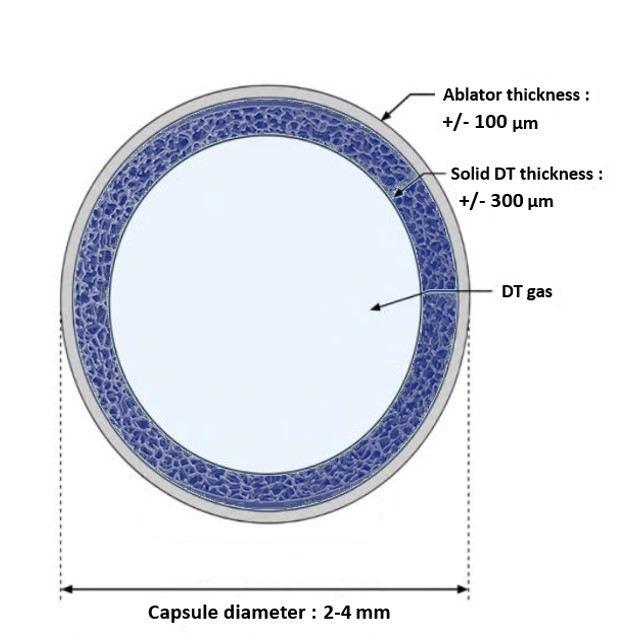
© GenF - CEA-Irig/DSBT
Figure : Schematic of a cryogenic target design for inertial fusion: an outer capsule acts as an ablator during compression, a 2PP foam (in blue) is impregnated with liquid or solid deuterium-tritium (DT) fuel, which is in equilibrium with its gaseous phase at the center.
The results obtained with the CHIMERA cell mark a first decisive step toward mastering the impregnation and solidification processes of cryogenic targets using 2PP foams. The next test campaign will aim to precisely quantify the impregnation dynamics, specifically by studying the influence of the structure and density of 2PP foams on this phenomenon. These data will enable us to refine the models and optimize the parameters to ensure homogeneity and reproducibility in line with the requirements of FCI reactors.
In the longer term, the goal is to design a solution suitable for a high rate (10 Hz), which is essential for feeding the TARANIS reactor under real-world conditions. The ultimate objective is to translate these results into a system capable of producing high-performance cryogenic targets at a high rate, while maintaining the design criteria necessary to maximize the thermonuclear gain.
inertial confinement fusion (ICF)*: fusion of hydrogen nuclei through the extremely rapid compression of a tiny fuel capsule (composed of a mixture of hydrogen isotopes—deuterium and tritium)—using very powerful lasers. To achieve maximum efficiency, the fuel is solidified at a very low temperature inside the capsule. The goal is to produce abundant, carbon-free, and sustainable energy.
thermonuclear gain*: the amount of energy produced by fusion reactions relative to the energy required to initiate them.
micrometric 2PP foams*: three-dimensional porous structures with a controlled architecture at the micrometer scale, manufactured by two-photon polymerization (2PP, a 3D printing technique using an ultrafast laser). These foams are designed to serve as cryogenic supports, enabling uniform impregnation of the liquid fuel.
laser speckle contrast imaging (LSCI)*: A laser speckle is a grainy pattern scattered by a surface illuminated by coherent laser light. By analyzing contrast variations and temporal changes, it is possible to detect physical phenomena such as the presence of a liquid.
UMR : DSBT - E 9004 CEA/UGA
Fundings : CEA et BPI via AAP Réacteurs Nucléaires Innovants - #DOS0237678/00
Collaborations : GenF