Understanding turbulent transport remains a major challenge in fluid physics, particularly for high Reynolds number's flows where multi-scale interactions become dominant. In this context, Taylor–Couette flow — between two coaxial cylinders in relative rotation — provides a good model system for investigating such phenomena. Indeed, it allows precise control of boundary conditions (i.e., what is imposed on the fluid at the walls, such as the rotation rates of the cylinders) and offers direct access to turbulent transport through torque measurements.
Conventional measurement techniques often rely on sensors mounted on rotating parts, which are difficult to implement in constrained environments, especially at low temperatures. However, the study of liquid helium, and in particular its
superfluid* phase, opens new perspectives for exploring forms of turbulence involving quantum mechanisms. This requires experimental devices capable of operating under extreme conditions while maintaining high measurement accuracy.
We have therefore developed an experimental setup in which only the inner cylinder rotates, while the outer cylinder is suspended from a torsion wire and directly acts as a torque sensor. The angular deflection of this cylinder, measured optically, allows the torque exerted by the fluid to be determined without the need for rotating instrumentation. An
eddy-current* damping system ensures rapid stabilization, enabling steady-state measurements.
The apparatus is designed to operate both with gases and with liquid helium over a wide temperature range. This flexibility makes it possible to cover more than five decades in Reynolds number and to explore both classical and superfluid regimes. Initial measurements show excellent agreement with known scaling laws in classical turbulence,
while also providing access to conditions where quantum effects may play a significant role in transport. Direct access to the torque enables a global measurement of angular momentum transport, which is particularly relevant for comparing these different physical regimes.
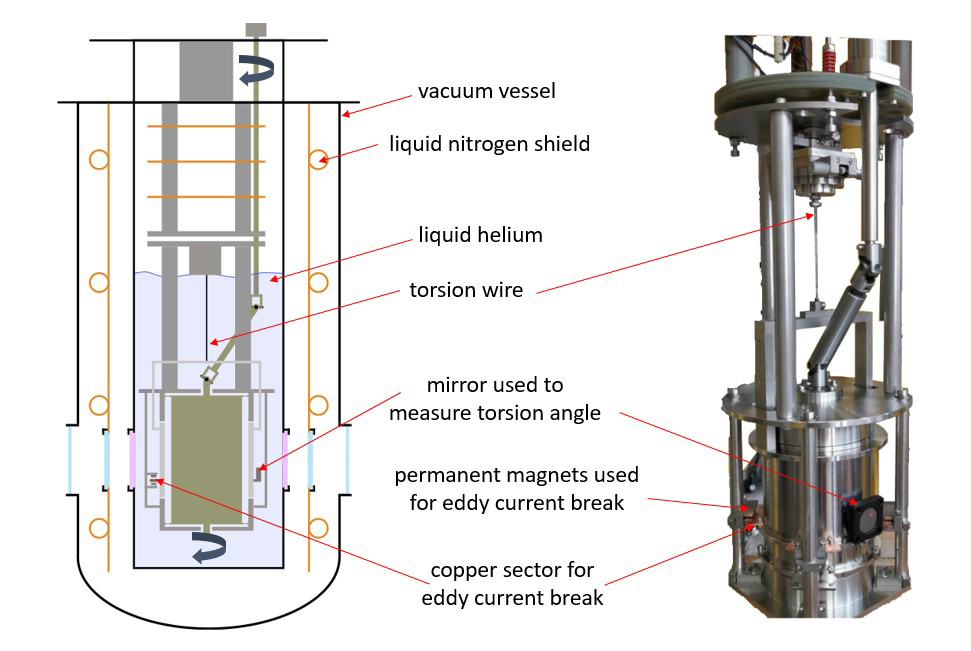
Taylor-Couette setup
© CEA-Irig/DSBT/LRTH
This new device therefore constitutes a versatile and pioneering experimental tool for the study of Taylor–Couette flow, using either classical or quantum fluids. Torque measurements provide a global diagnostic of turbulent transport, paving the way for a better understanding of the differences and similarities between classical and quantum turbulence.